The Ion Track: What It Is and Why Researchers Care
An ion track is a thin channel, a few nanometers in diameter, left in a solid after a single ion has passed through. This small zone of altered material is the starting point researchers use for filters, sensors and templates for nanostructures. Two questions follow: how does such a track form, and which materials are suitable?
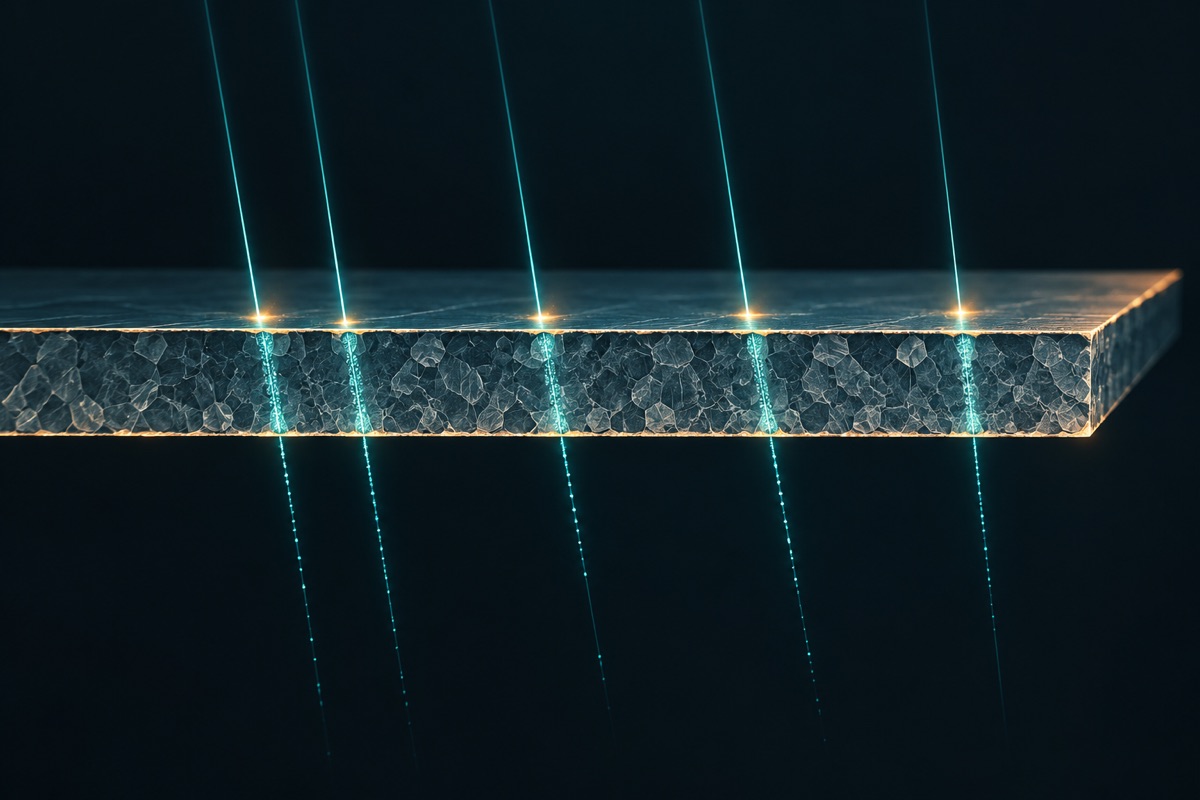
What is an ion track?
While crossing a solid, an ion keeps giving up energy. The energy released per unit of path length is called the energy loss. For fast, heavy ions the interaction with the electrons of the material outweighs the interaction with the atomic nuclei. If the energy loss exceeds a threshold that depends on the material, an ion track forms. Below that value the ion passes through the material without changing its structure permanently.
The track measures only a few nanometers across, but its length depends on the ion's energy and on the material. The ion thus leaves a narrow zone of altered structure in the solid, one that is very long compared with its diameter and that can later be put to practical use.
Which materials are suitable for tracks?
Polymer films, some glasses, mica and a few crystals are the best studied. Each of these materials has its own energy loss threshold. The choice of ions and their energy therefore depends on the material being irradiated in a given experiment. Irradiation is carried out with particle accelerators. Irradiation time and beam current let you adjust the track density, so single tracks as well as very densely spaced ones can be produced.
From Track to Pore: The Role of Etching
The material along the track is chemically more reactive than its surroundings. An etching solution removes it faster, and the track turns into a pore. The pore can be cylindrical, cone-shaped or double-conical. Its shape depends on the type and concentration of the etchant, the temperature, the etching time and the additives in the solution.
The pores in a film have a similar diameter because each track arose from the same physical process. This evenness is one of the main reasons ion tracks are studied so intensively.
Why the topic interests researchers
The applications are varied. They range from filtration to sensing with single nanopores and from detectors for particle tracks to geology, where fission tracks in minerals are evaluated. Templates for nanostructures form a group of their own.
In the template method, one side of the membrane is covered with a conductive layer. A metal is then deposited electrochemically in the pores. After the polymer is dissolved, wires, tubes or cones remain. Their shape follows directly from the pore shape and therefore from the etching settings.
The ion track thus joins a simple idea to wide possibilities of use: an ion creates a track, and chemical treatment turns it into a pore of controlled shape. For research this becomes a tool for designing structures on the nanometer scale on purpose.