Etching Ion Tracks: How a Track Becomes a Pore
Etching is the step that turns invisible damage inside a material into an open pore. Irradiating a film with ions does not by itself punch holes in it. All it leaves behind is a track, a narrow zone whose properties have changed. Only the chemical etch decides whether an opening forms and what it looks like. Below we walk through how the process works, what sets the pore shape, and why the pores in a single film resemble one another so closely.
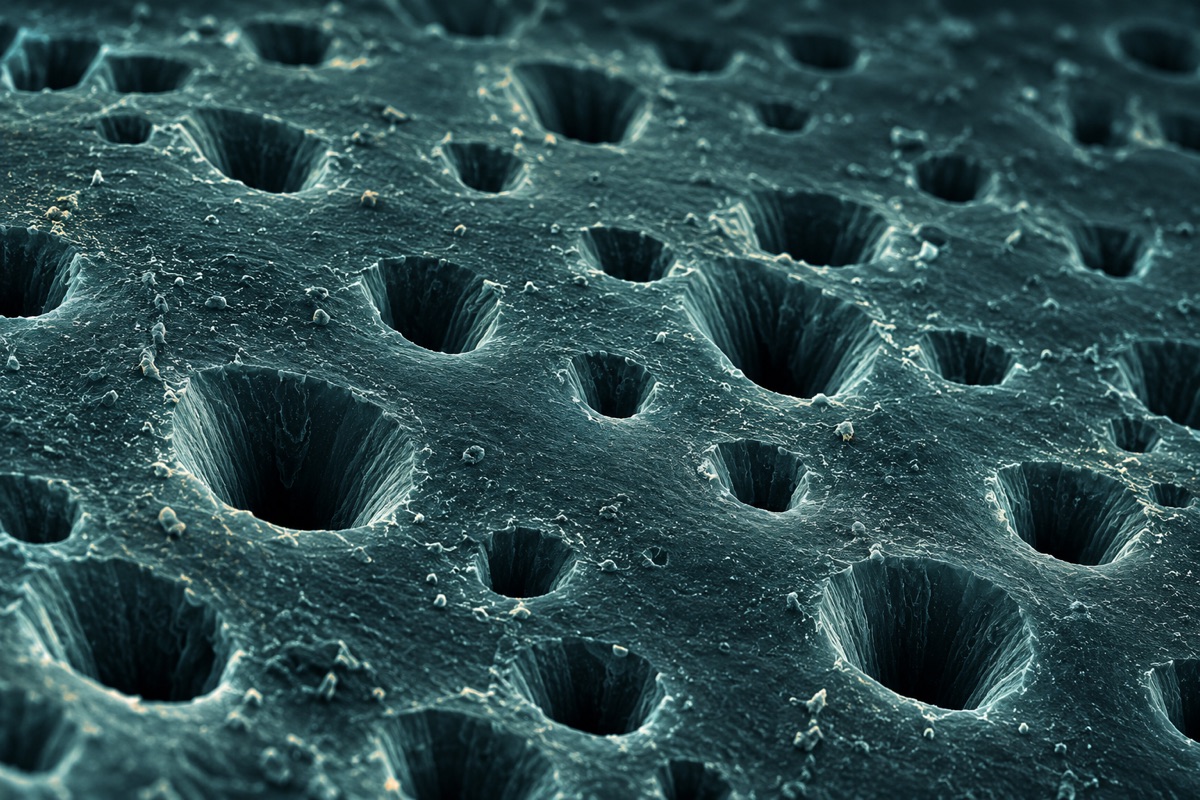
Where does the track in the material come from?
An ion moving through a solid keeps losing energy along its path. That quantity is called energy loss. For fast, heavy ions, the main interaction is with the electrons of the material. When the energy loss rises above a threshold that depends on the material, a track forms.
Such a track is only a few nanometers wide. How long it is depends on the ion's energy and on the material. Polymer films, some glasses, mica and a handful of crystals are the best studied cases. The irradiation takes place in particle accelerators, and the irradiation time and the beam current set how dense the tracks are. So the number of pores the finished membrane will have is already fixed at this stage.
How does the etching of ion tracks work?
Along the track the material is chemically more reactive than the material around it. An etching solution therefore removes it faster, and the narrow track opens into a channel. Over time the channel widens, because the etchant also attacks the walls, only more slowly than it attacks the track axis. That is how a track becomes a pore.
What matters is that the removal rate along the track differs from the rate outside it. If the two were equal, no distinct channel would appear. The film would simply thin out evenly over its whole surface.
What determines the shape of the pores?
Pores can be cylindrical, cone-shaped or double-conical. The shape depends on the type and concentration of the etchant, the temperature, the etching time and any additives in the solution. Changing one of these settings pushes the result toward a different pore profile. A longer etch usually gives a wider channel, while the remaining conditions decide whether it ends up cylindrical or conical. The exact concentration and temperature depend on the material, so every material needs its own etching conditions.
Why are the pores so similar to one another?
The pores in one film have similar diameters because every track came from the same physical process. Each ion loses energy by the same rules, so the tracks match. With identical etching conditions the result is a homogeneous porous membrane whose pores differ only slightly.
What are such membranes used for?
Uses range from filtration to sensing with single nanopores and from detectors for particle tracks to geology, where fission tracks in minerals are studied. Membranes also serve as templates for nanostructures.
In the template method, one side of the membrane is coated with a conductive layer. A metal is then deposited electrochemically inside the pores. Once the polymer is dissolved, wires, tubes or cones remain, shaped like the pores they grew in. The etching settings therefore affect not just the membrane itself but also the structure that can be cast in it.
Etching ion tracks thus links two steps: the physical creation of the track and the chemical making of a pore from it. The first step fixes how many openings there will be, and the second gives them their final shape.